Sculpting Phoenician Memory
From bronze to old gold, sixty years of creation between Beirut and Paris.
Works
A selection of works, from 1965 to today, available to order upon request.
Sixty years of a single quest: giving a body to Phoenician memory.
Bronze is his memory. Steel, his dignity. And silence, his most honest tongue.
Antoine Berberi is born facing the Mediterranean, on the shore that invented the alphabet and the first sails. As a child in Beirut, he learns that the sea is not a border: it is a path.
The path of Bou Saydoun, first sailor of the legends. That of Elissa, princess of Tyre who became queen of Carthage. These tales, he will carry them all his life, until he gives them a body, a patina, a weight in the hands.
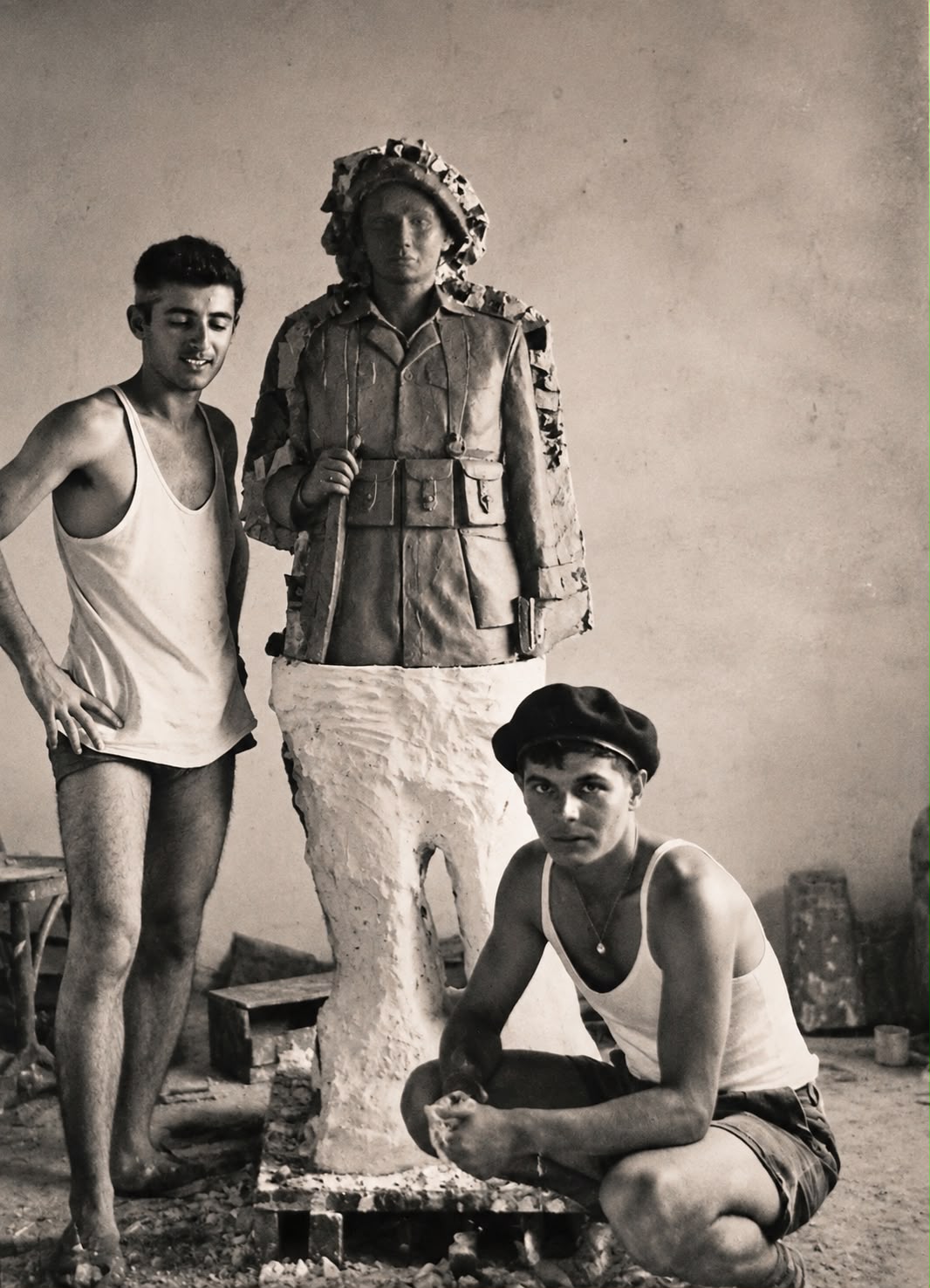
He is twenty when the doors of the Beaux-Arts open for him in Paris, in the studio of Hubert Yencesse. Far from his sea, he discovers another homeland: that of the true gesture.
There Les Esprits I is born, a work cast with his own hands. There, too, the pact of a lifetime is sealed: to keep the material under his own hand, from the first day to the last. The modelling, the wax, the pour, the patina: all of it will be born of his gestures.
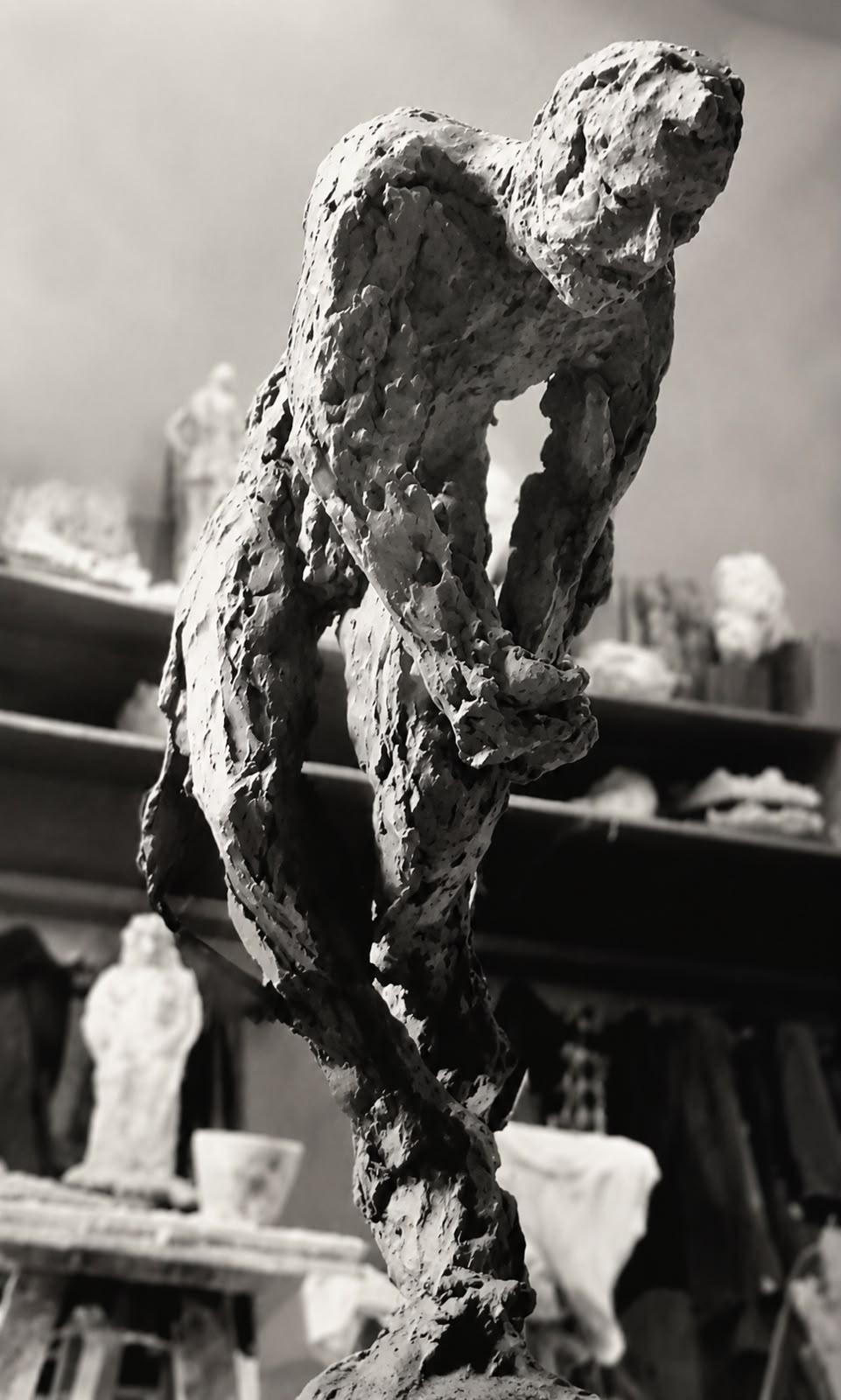
Fire becomes his home. A trade that few hands, in the world, still practise whole, and of which he alone remains master, from sketch to finished bronze. Picture him there, in the heat of the fire, watching for the instant when bronze embraces the void left by the wax. His alloy bears the name of a dusk: the old gold.
His patinas borrow their colours from landscapes, Florentine green, reddish caramel, bark brown. Under light, this old gold carries an inner glow, almost secret. When bronze falls silent, steel takes up the word. On every notice returns the same phrase, like an oath: cast by the artist. Three words that say everything: for him, to shape matter is a way of loving.
'I am not a static sculptor. That is precisely why I work neither stone nor marble.'
Antoine Berberi, L'Orient-Le Jour, 2003
Phoenicia is, for him, a mother tongue, not an antiquarian backdrop. Each silhouette seems carved from within, as though the legend had taken on flesh under his hand. Elissa rises for the entrance of Tyre, honoured as early as 1970. The winged disk of Alphabetael brings the letters into bloom.
The trireme of the First Sailor, that 'Tradfat' christened by the poet Saïd Akl, swells its sails of bronze. Berythe, Damo, Mirdia: recovered names, returned to the world like light to buried faces. Work after work, the same gesture begins again: to set sail, to hand down, to be reborn.
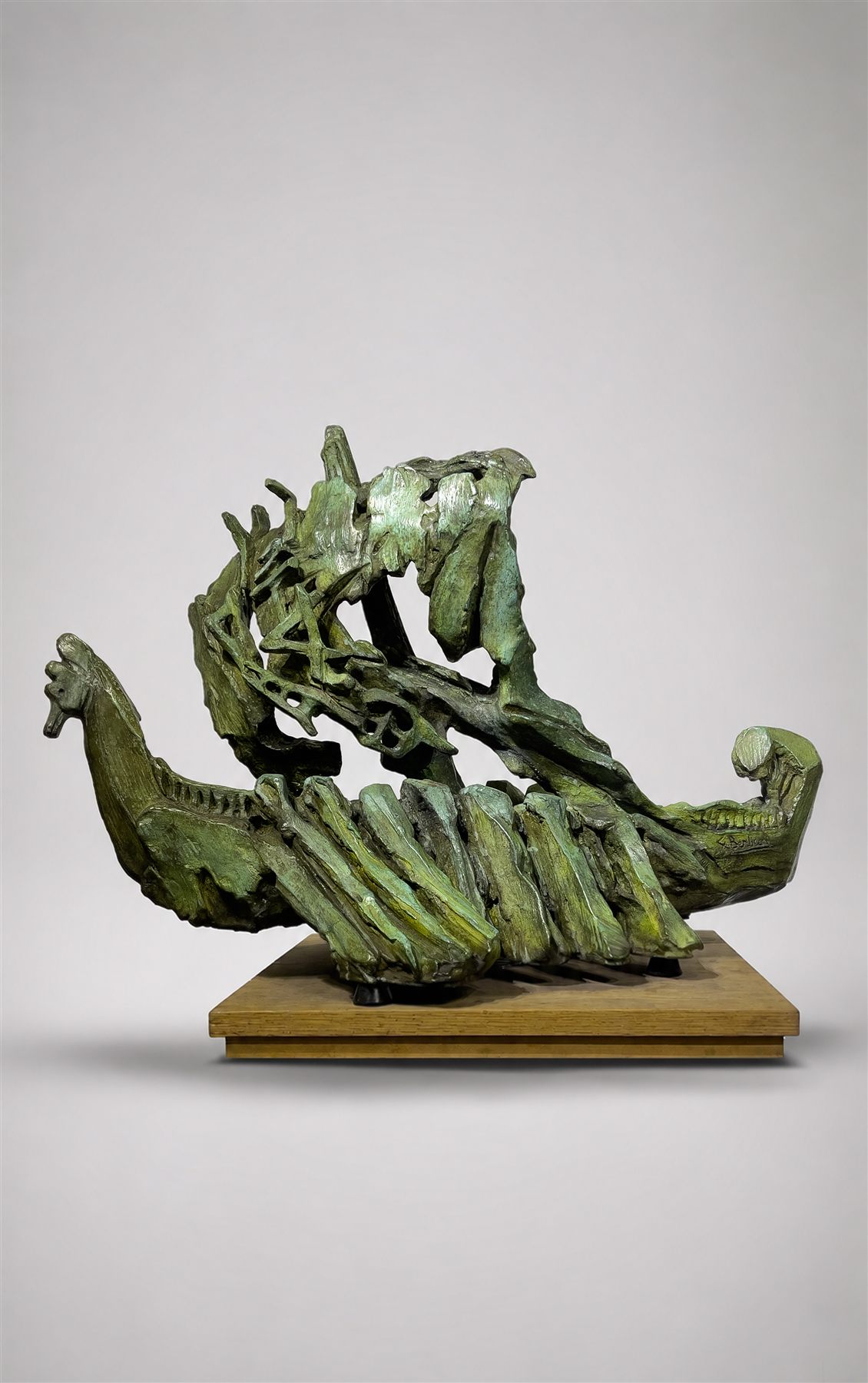
'I am interested in human life on its spiritual side and on its narrative side,' he would one day confide. Story and breath, history and soul: that, perhaps, is his true rarity, even more than his material. Deeply attached to his country, he has made of it a universal language. Courage, freedom, at times exile: always with that reserve of great artists, who suggest more than they impose.
His country, he has sculpted it in its glory as in its wounds. His art was born from the chaos of a civil war he would say he suffered enormously through. Since then, he chooses to raise memory rather than watch it fade: the statue of President Bechara El-Khoury keeps watch over Beirut, while the memorials of Ghazir and Chartoun hold the names of the departed.
Already in the midst of war, The Plea for Peace had risen like a prayer of steel. Then came Revolution, finished weeks before August 4, 2020, and the Blast masks, faces of dread cast in bronze. Above it all, a dream still to be fulfilled: The Cedar of Liberty, a fountain at its base, as a symbol of life.
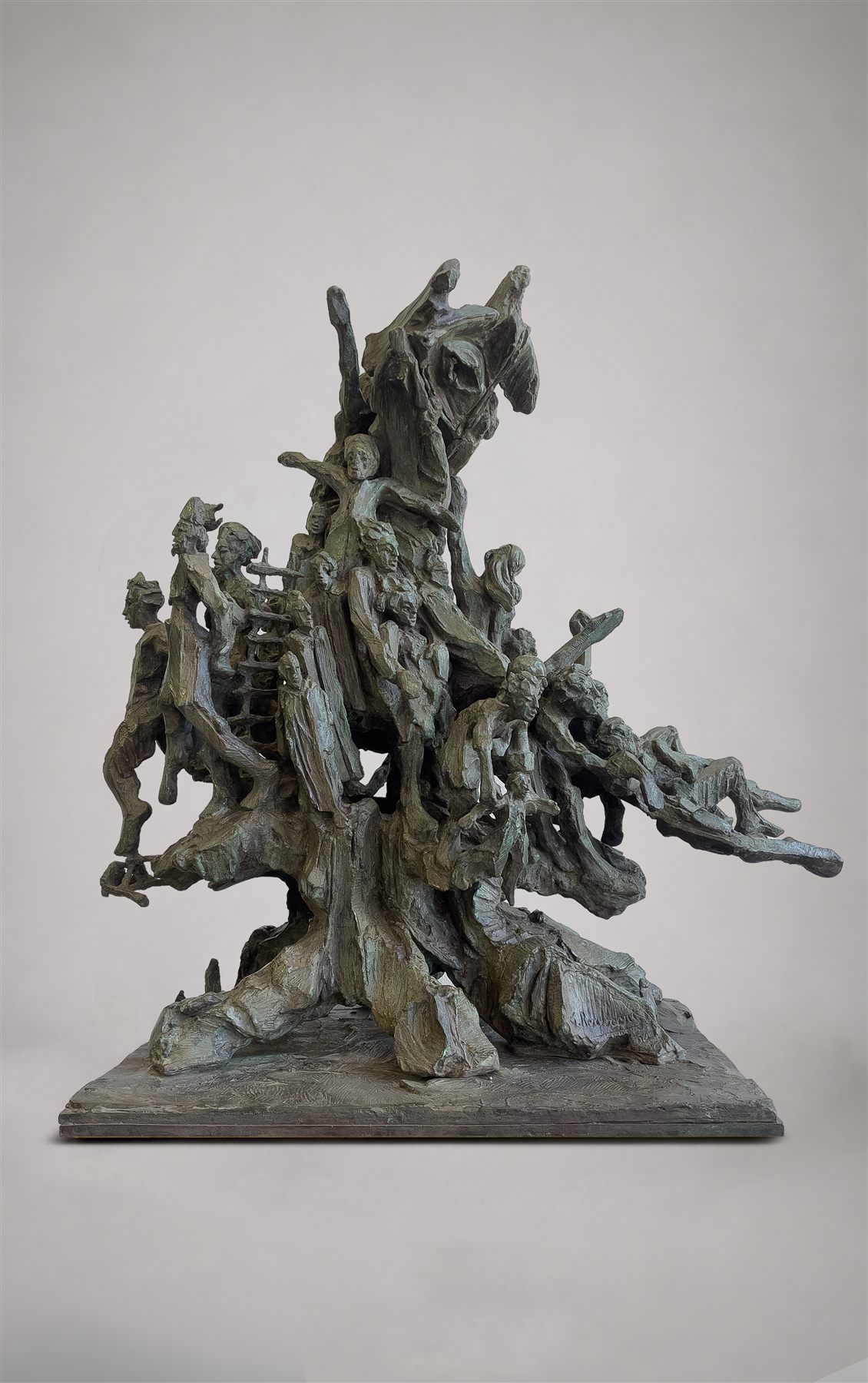
Each monument stays rooted in its native ground. But his name travels. Decade after decade, he is discovered further afield, until the whole world comes looking for his bronzes.
His works have crossed the seas, like the sails of his Phoenician ancestors. Four continents welcome them. The course has stayed the same since the first day: to make of Lebanon a living promise.
Past eighty, in the studio of Klayaat, the casting goes on. The fire, still, stays alive.
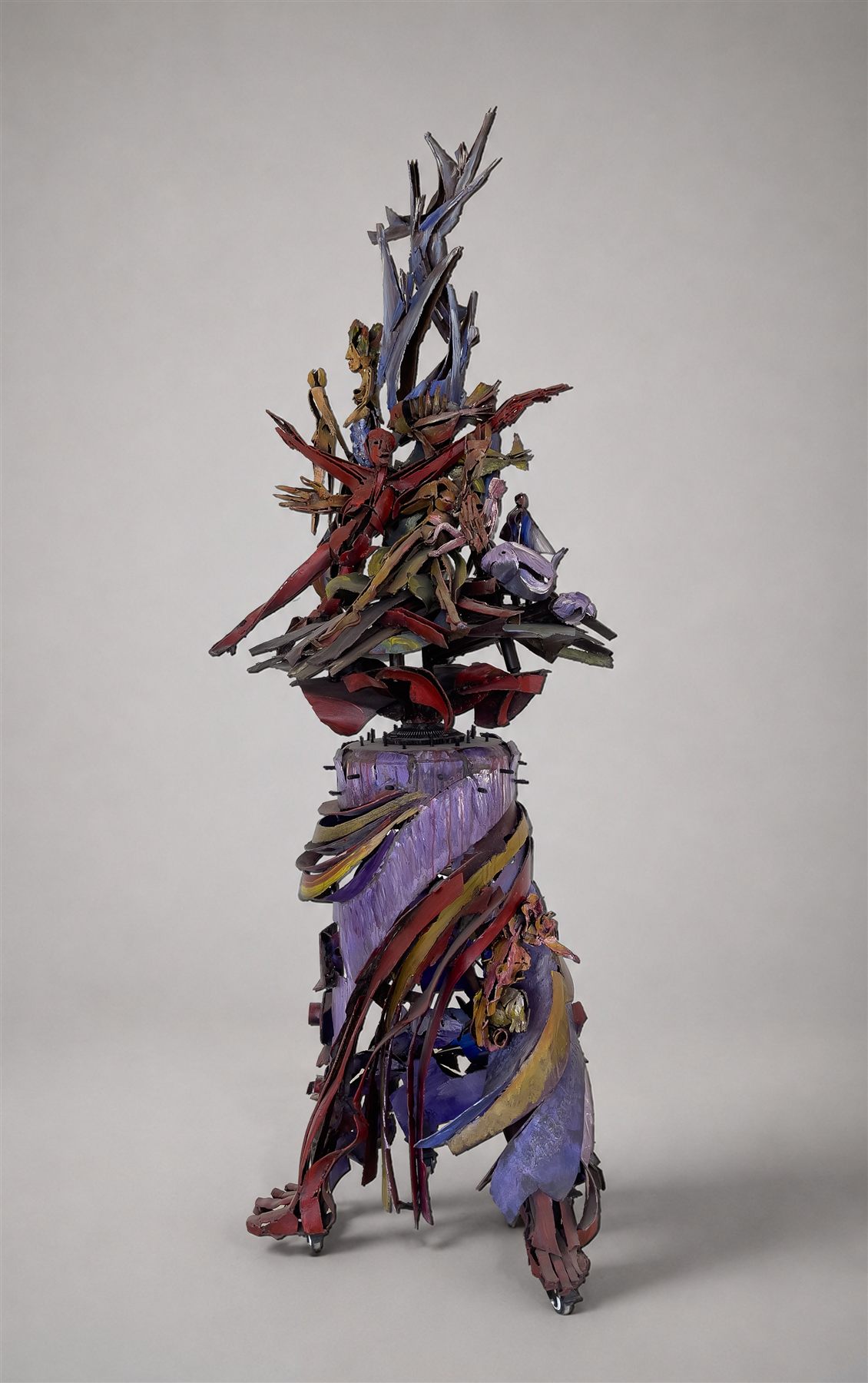
Sculpture, for Antoine Berberi, is a breath before it is an object: a silent encounter where matter becomes emotion, where the gaze of the creator meets that of the visitor.
Today, in his studio, Antoine Berberi continues to sculpt. Every new work carries the same conviction, dear to the great masters: true art is felt before it is seen, it inhabits memory and leaves, in the present as in the future, the quiet and profound imprint of beauty.
The Foundry
Genesis of the Cellist: a double-bass musician, captured step by step by the camera. The mould still warm, the pour, the assembly, the pickling, the gold leaf: every stage stays under his eye, from the first gesture to the last. This total command gives each bronze its share of the irreplaceable.
The bronze pour, Klayaat workshop
"The void and the full invade the rhythms of our lives."Antoine Berberi
Biography
Antoine Berberi is born in Beirut on 5 July 1944. As a child, he discovers his calling early: he buys his first clay and sculpts, in two hours and without lesson or model, the face of his father.
He continues his training with the sculptor Youssef Ghossoub, then at the Lebanese Academy of Fine Arts, where he is the only sculpture student in his class, taught notably by Zaven Hadichian, Nicolas Nammar and Nadia Saïkali.
A scholarship from the Lebanese Ministry of Education and Fine Arts sends him to the École Nationale Supérieure des Beaux-Arts in Paris, in the studio of Hubert Yencesse, chief restorer of France's monuments, who involves him in the restoration works of the Arc de Triomphe. As early as 1963, he receives the First Mention in Sculpture for Les Esprits I, a founding work cast with his own hands, followed the next year by the school's First Prize for Foreign Sculpture.
He also trains in monumental sculpture under Gérard Ramon, working with him on several sculptures for the town of Villepreux, in France. In 1965, he is admitted to the French Federation of Graphic and Plastic Arts Societies and exhibits for the first time at the Musée d'Art Moderne de la Ville de Paris.
Back in Lebanon in 1967, he founds his own art foundry in Dbayeh, where he casts his own bronzes using the lost-wax method, following an « old gold » alloy he develops himself. That same year, he receives the Sursock Museum Prize. From 1967 to 1975, he teaches sculpture, drawing and artistic anatomy at the Lebanese Academy of Fine Arts. These foundry years also see the birth of the monumental slides of Beirut's International Park, in 1969, followed by the busts of Bishop Antonios Bachir and President Fouad Chéhab.
In 1970, his sculpture of Elissa, princess of Tyre, earns him the Rotary Club of Beirut Prize. In 1973, the Saïd Akl Prize honours his memorial to Lieutenant Samir Chartouni, who fell for justice. In 1975, an imperial commission takes him to Tehran: four monumental steel sculptures for Shahinshahi Park, Industry and Development, The Forest, Water Symbol of Life and Glory to Man and the Horse. L'Attachement à la Terre, in Ghazir, closes this first decade of public commissions in 1977.
From 1979, his monuments take on a national, then international scale: The Plea for Peace rises in Meyrouba, the Monument to Saint Charbel, in stainless steel, joins the Lebanese community of Windsor, Ontario, in 1981, and the Unknown Soldier stands in Aoukar in 1986. In 1985, he opens his first permanent exhibition hall in Jounieh, alongside his wife Irène, a concert pianist. That same year, French Minister of Culture Jack Lang names him Chevalier of the Order of Arts and Letters.
Between 1990 and 1993, he exhibits in Paris, at the Salon d'Automne of the Grand Palais and then at the Orangerie of the Château de Versailles, while sculpting, for the Grande Loge de France, the busts of its dignitaries Richard Dupuis and then Guy Piau. He exhibits his works in solo shows at Galerie Melki (1992) and Galerie Furstenberg (1996), Paris. In 1995, at the initiative of Prime Minister Rafic Hariri, his monumental statue of Rachid Karamé is erected in Beirut, cast entirely in his Dbayeh studio.
In 2000, the press describes him as « a resistant in his art foundry », one of the last to master the entire bronze process alone. In 2001, on Rafic Hariri's recommendation, he undertakes the monumental statue of President Béchara El-Khoury, inaugurated in 2005.
In 2004, he presents at the Salon d'Automne the direct plaster of his project for a Martyrs' statue shaped like a cedar, bearing at its base a fountain symbolising life; the following year, at the same Salon, he unveils the bust of the poet Saïd Akl, Prince of Lebanon. In 2006, a retrospective of over seventy works, « A Look at My Work », is devoted to him at the Galerie Surface Libre, in Jal el-Dib. In 2009, he casts in bronze, using the lost-wax method, a new version of the monument to Lieutenant Samir Chartouni, inaugurated in Chartoun thirty-six years after the first tribute.
In 2011, the bust of General Khalil Kenaan joins the Officers' Club of Yarzeh. The following year, he founds a new monumental art studio with a lost-wax foundry in Klayaat, in the Keserouan. His works join public and private collections across four continents, from the Yinchuan Museum of Modern Art, in China, to Carnegie Mellon University in Doha.
After the tragedy of 4 August 2020, he sculpts Revolution and the Blast masks. He now lives and works in his Klayaat studio, where the casting of bronze continues.
Awards & Honors
Notable Exhibitions
Blog
Four decades of press coverage of Antoine Berberi, from the Lebanese and French press.
Enquiries
For any enquiry regarding a work: acquisition, exhibition, press or monumental commission. The gallery replies personally to every message; conditions are communicated upon request.